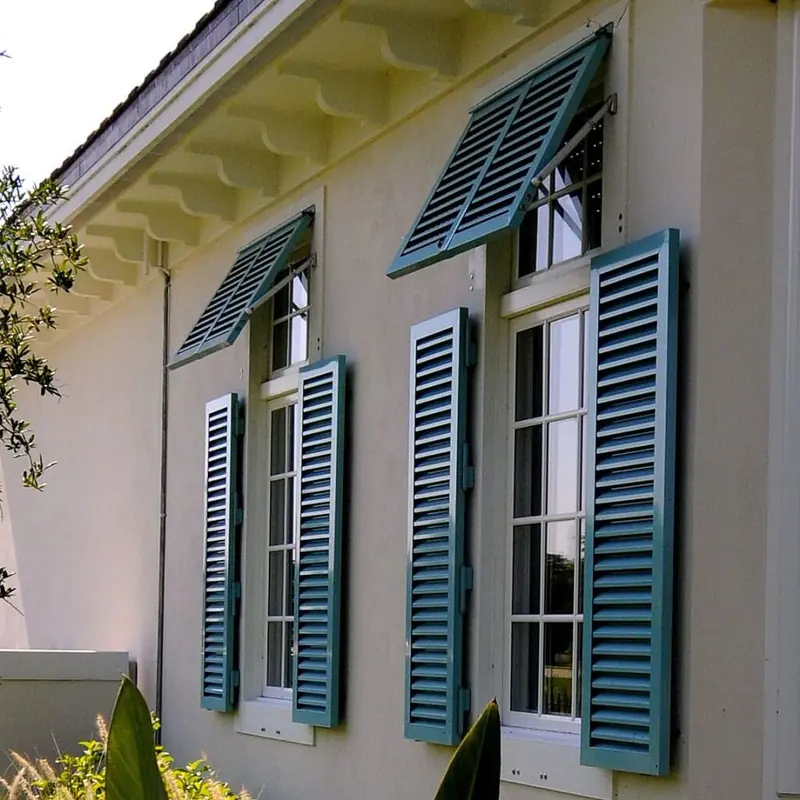
The Bahama vs Colonial shutters question comes first on any exterior job, because the two styles do different work on a Florida wall. A Bahama shutter is one panel hinged at the top of the window and propped out at an angle, so it shades the glass. Colonial shutters hang in pairs at the sides of the window and frame it. We install both from New Horizon Shutters, a South Carolina manufacturer of aluminum Bahama, aluminum Colonial and polymer composite shutters, so the comparison below comes down to your house, its windows and the way the sun hits them.
How Bahama shutters work
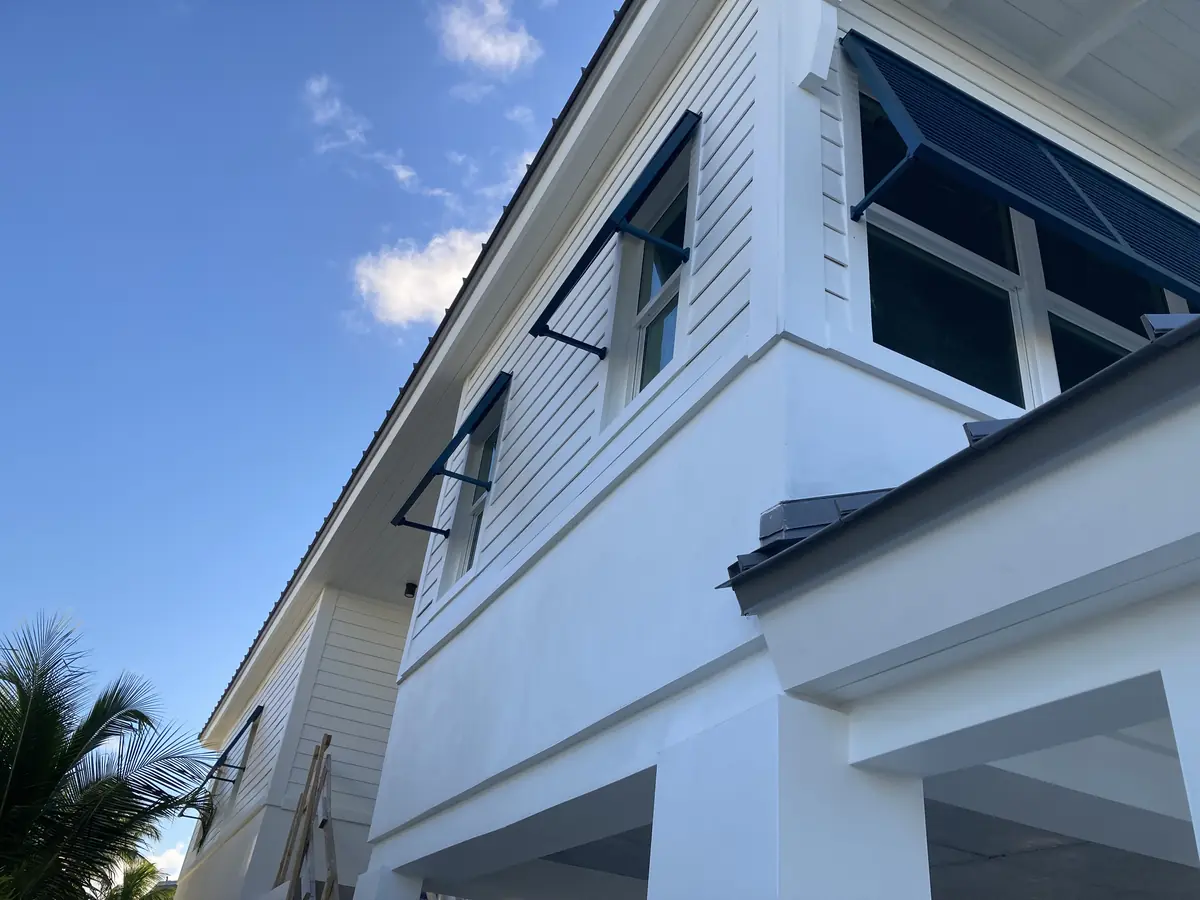
A Bahama shutter (some catalogs call it a Bermuda shutter) hangs from a hinge rail fixed to the wall above the window. Two stay arms hold the bottom edge out from the wall, so the shutter sits at an angle like a louvered awning. Sun from above lands on the shutter, daylight comes in underneath it, and air moves through the louvers.
That angle is what made the style at home in the islands and along this coast. On a west wall at 4pm in August the sun is aimed straight at the glass, and a propped Bahama shutter keeps it off the window for much of the afternoon while you still see the yard below. Against a plain stucco wall it also adds a shadow line and a depth that bare openings lack. See our Bahama shutters page for materials and options.
What to check before you choose them
A propped Bahama shutter sticks out from the wall, and its bottom edge sits lower than people expect. Look under every window for walkways, air conditioning condensers, hose bibs, shrubs and outswing casement windows, since any of those can rule a Bahama shutter out. From inside you lose the top of the view, and the room is dimmer than with bare glass, which on a west-facing room is the point and on a north-facing one is a cost.
How Colonial shutters work
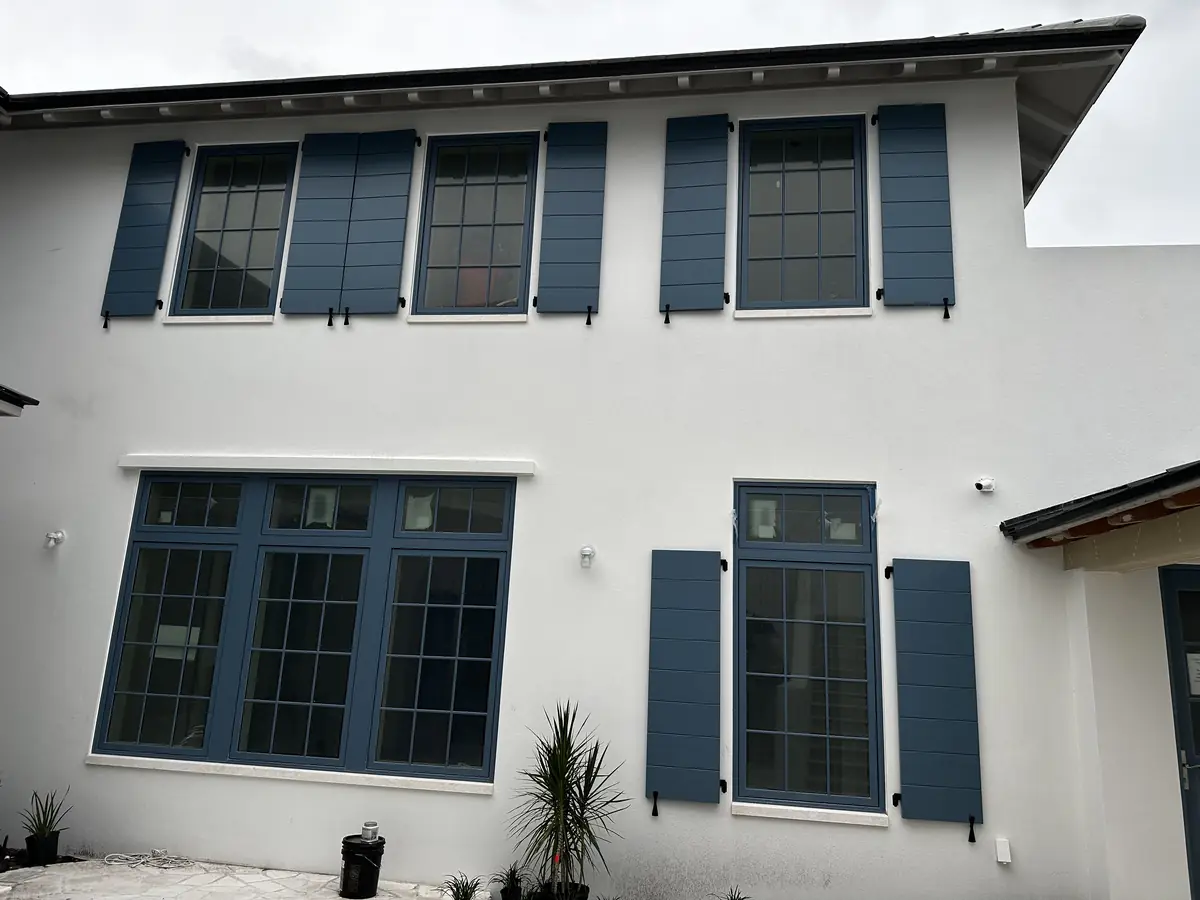
Colonial shutters hang in pairs, one on each side of the window, on hinges set into the casing or the wall. Open, they lie flat against the wall, held back by S-shaped holdbacks called shutter dogs. When they are closed, the two panels meet in the middle and cover the glass, which is why a correctly sized Colonial shutter is half the width of the window and the full height of the opening. The measuring rules are set out in how to size exterior shutters.
This is the shutter of the two-story porch house, the Colonial Revival and the Southern traditional home, and on a facade with evenly spaced windows it makes the house look finished. Louvered faces are the classic look. Raised panel and board and batten faces follow the same sizing rule with a solid face in place of louvers, and our Colonial shutters page covers the hinged and fixed options.
Where Colonial shutters struggle
Colonial shutters need flat wall on both sides of the window, at least as wide as each shutter. Corners, downspouts, coach lights, the next window over and the electric meter all eat into that space, and a pair squeezed down to fit looks wrong from the street. Open, they give the glass no shade at all, so on a west wall they do nothing for the afternoon heat.
Bahama vs Colonial shutters side by side
For most houses the decision turns on three rows of this table: shade, the space each style needs, and projection.
| Bahama shutters | Colonial shutters | |
|---|---|---|
| Hinged | At the top, on a rail above the window | At the sides, on the casing or wall |
| Per window | One panel, the full width of the window | A pair, each half the width of the window |
| Shade when open | Shades the glass like an awning | None; the panels sit flat beside the window |
| View from inside | Loses the top of the view | Unchanged |
| Space it needs | Clear wall above, clear ground in front and below | Flat wall on both sides, as wide as each shutter |
| Projection | Stands out from the wall on stay arms | Lies flat against the wall |
| Suits | Raised coastal homes, cottages, plain stucco openings | Symmetrical facades, porch homes, two-story traditional houses |
| Storm use | Both can be built to close over the glass. Storm protection depends on the product's approval (see below). | |
Shade, heat and the direction each wall faces
Shade outside the glass does more for heat than shade inside it, because the sun is stopped before it passes through the window. That is the physics behind awnings, deep eaves and Bahama shutters. A Colonial shutter only helps with heat when it is closed, and a closed shutter means a dark room.
Before you choose, stand in each room at about 4pm on a sunny day and note where the glare lands. Walls facing west and south are where a Bahama shutter earns its place. On north and east walls the shade matters less, so let the look of the house decide.
Storm protection: decorative or functional
Both styles can be built to close over the glass. Functional Bahama shutters come down off their stay arms and are secured at the bottom; a functional Colonial pair swings shut and latches across the middle. From the street, a decorative shutter and a rated one can look identical, so if storm protection is part of the reason you are buying, ask for the product approval for the exact model and size and check it with your building department before you count on it.
Every shutter you plan to close before a storm has to be reached, and on the second floor that means a ladder. If the house already has impact-rated windows, those windows are the storm protection and the shutters can be chosen for shade and looks alone.
One customer started with two windows and came back for more:
“Marty and his son were professional, knowledgeable, highly skilled and a pleasure to work with. Gulf Coast installed decorative hurricane shutters on two windows at my home and I was so pleased that I ordered five more sets.”
Which style suits which house
- Raised beach houses and island cottages: Bahama shutters, the style these houses grew up with.
- Two-story traditional and porch homes: Colonial pairs on every window of the front elevation.
- Concrete block ranch homes with stucco: either works. Bahama shutters add depth to a flat wall, and Colonial pairs suit a front with evenly spaced windows and room between them.
- Metal-roof cottages and farmhouse styles: side-hung shutters, louvered or board and batten.
- Wide picture windows: the hard case for both. A Colonial pair sized to cover the glass gets wide enough to crowd the wall, and a single Bahama panel across it gets large. Work this one out on site, with the wall in front of you.
Using both styles on one house
Plenty of Gulf Coast houses carry both styles, and the mix works when there is a reason for each. A common split puts Bahama shutters on the upper floor or the sunny side and Colonial pairs on the front windows at ground level, the arrangement in the teal photo at the top of this page. Keep the color and louver look the same on both so the house reads as one design.
Color, HOA approval and salt air
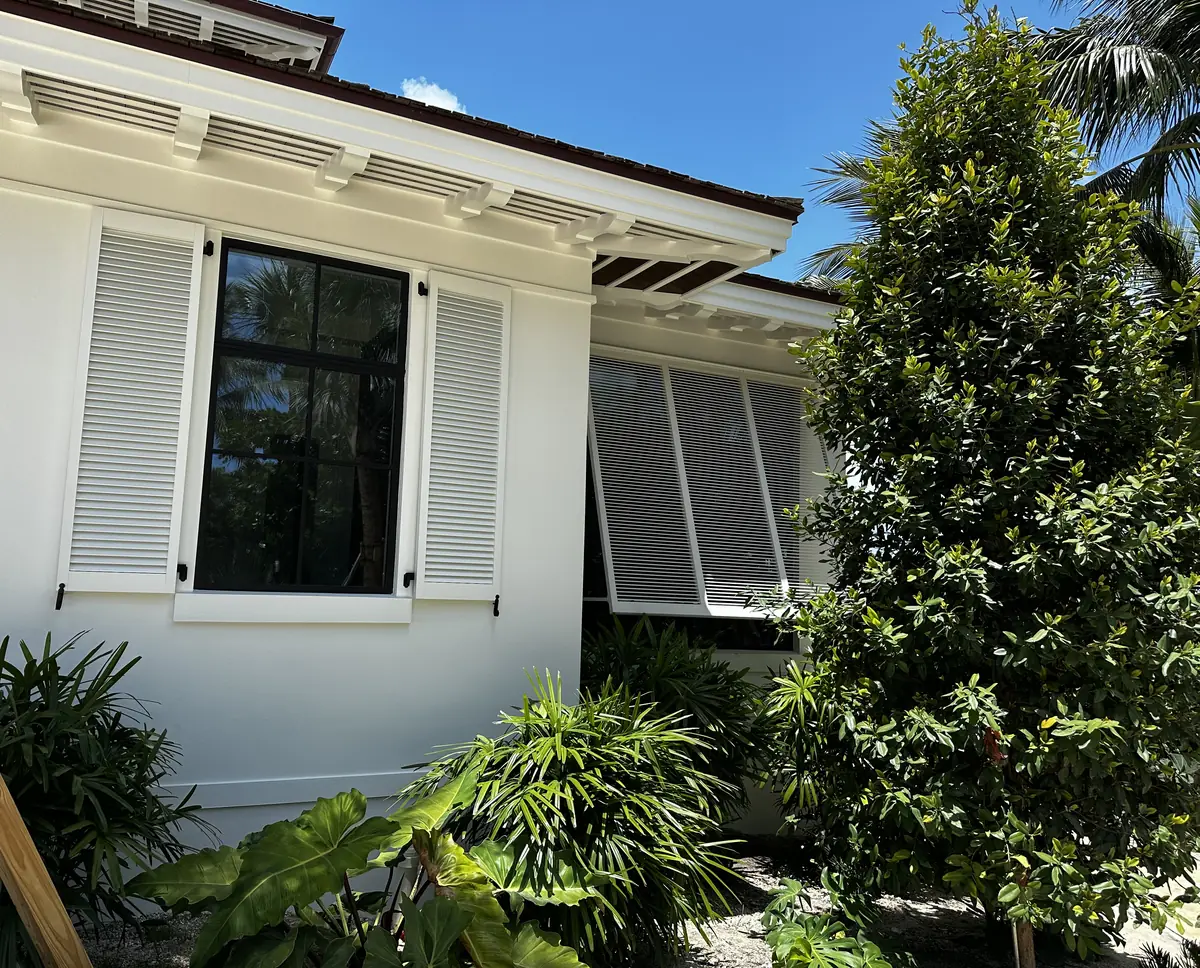
Many communities review exterior changes before anything goes on the wall, and some keep an approved color list. We give you the style, size, color and placement details the architectural committee asks for, and we can work to an approved color. Near the water, salt film builds up on any exterior shutter. Aluminum does not rot or swell, but the finish still wants a rinse with fresh water every few months, and the closer you are to the Gulf, the more frequent that rinse should be.
What to settle before the estimate
- Which windows take direct afternoon sun
- What sits under, beside and above each window
- Your HOA's rules and color list, if there is one
- Storm closure, or shade and looks only
- Photos of houses you like
With those notes in hand, book a free in-home estimate. Marty measures every window, checks the wall space and clearances, and brings samples so you can see the colors against your own stucco or siding. Our exterior shutter installation page walks through the rest of the process.
Questions homeowners ask
Are Bahama shutters and Bermuda shutters the same thing?
Yes. Both names describe a single shutter hinged at the top and propped out at an angle on stay arms. Some manufacturers use one name and some the other.
Can Colonial shutters go on a double window?
Yes, if the wall allows it. Treat the double window as one opening: each shutter is half the combined width, so a pair of 36-inch windows needs two 36-inch shutters and that much flat wall on each side. If the wall cannot take it, a Bahama shutter on each window, or no shutters on that unit, will look better than a narrow pair.
Do Bahama shutters make a room dark?
They make it dimmer. The shutter blocks direct sun and the sky above the window, and daylight still comes in under the bottom edge. On a west-facing room that trade is the reason to buy them; on a north-facing room it is harder to justify.