Vertical blinds are the builder-grade standard on Florida sliders, and once the vanes fray or the chain jams, the question becomes what to put up instead. Of the window treatments for sliding glass doors, the two we install are plantation shutters and roller shades, and they solve the problem in opposite ways. Shutters give you louvers to tilt and panels you slide or swing out of the way. A roller shade winds its fabric up out of sight and leaves the whole door clear. For the wider picture across every room, see our interior window treatments overview.
What window treatments for sliding glass doors have to handle
- Traffic. A slider opens many times a day, so whatever covers it has to clear the moving panel quickly.
- The handle. It stands off the glass, and anything hanging in front of the door has to clear it.
- Low sun. A west-facing slider takes the late afternoon sun at the worst angle, straight across the floor and onto the TV.
- Width. Sliders run from a six-foot two-panel door to walls of glass three and four panels wide.
- Night privacy. With the lights on inside, a bare slider puts the room on display to the lanai and the yard.
Bypass plantation shutters
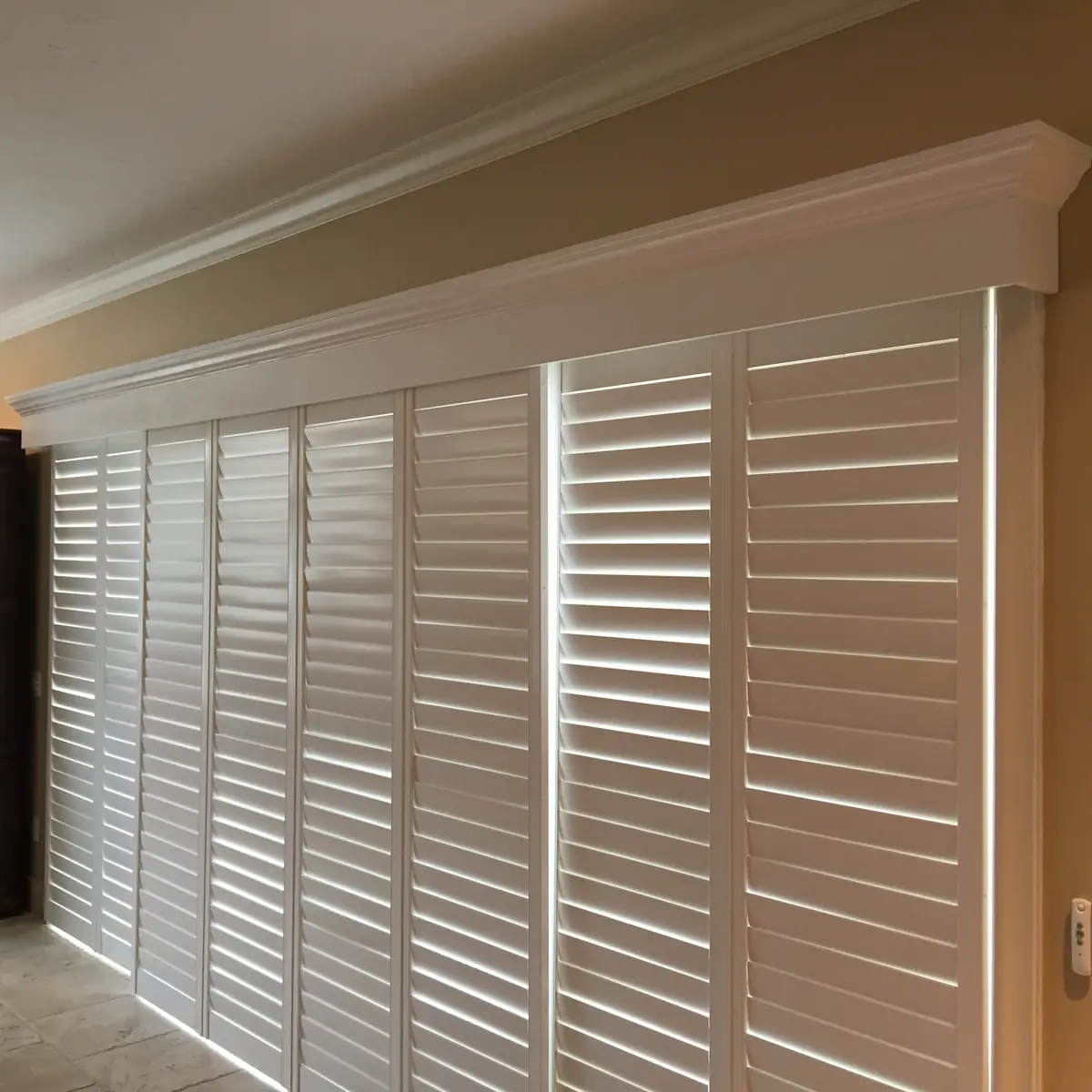
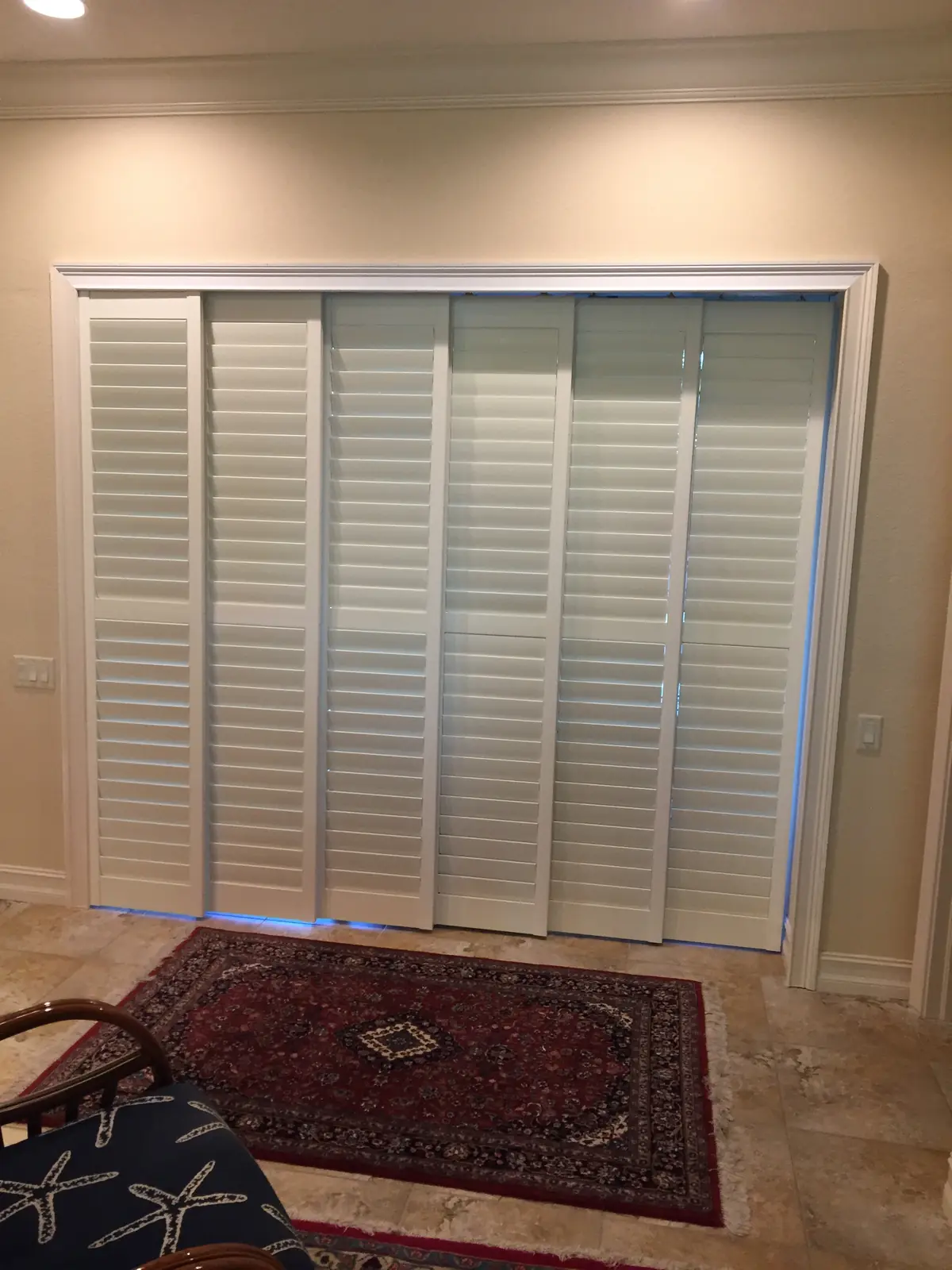
Bypass shutters hang from two or more parallel tracks mounted above the door, so the panels slide past each other. To use the door, you slide the panels over the fixed side of the slider and leave them there, and the moving glass panel is clear. Closed, they cover the full opening and the louvers tilt like any other plantation shutter, so you can angle the light up toward the ceiling, keep the room private and still have daylight.
The trade is the view. Stacked panels always cover the fixed side of a two-panel slider, so you never see the whole opening at once. Panel width matters too: plain poly tops out around 24 to 28 inches before it sags, so an eight-foot slider needs at least four panels, where AlumaCore panels up to 36 inches wide can cover it with three. Fewer panels means fewer stiles across the glass.
Hinged shutter panels
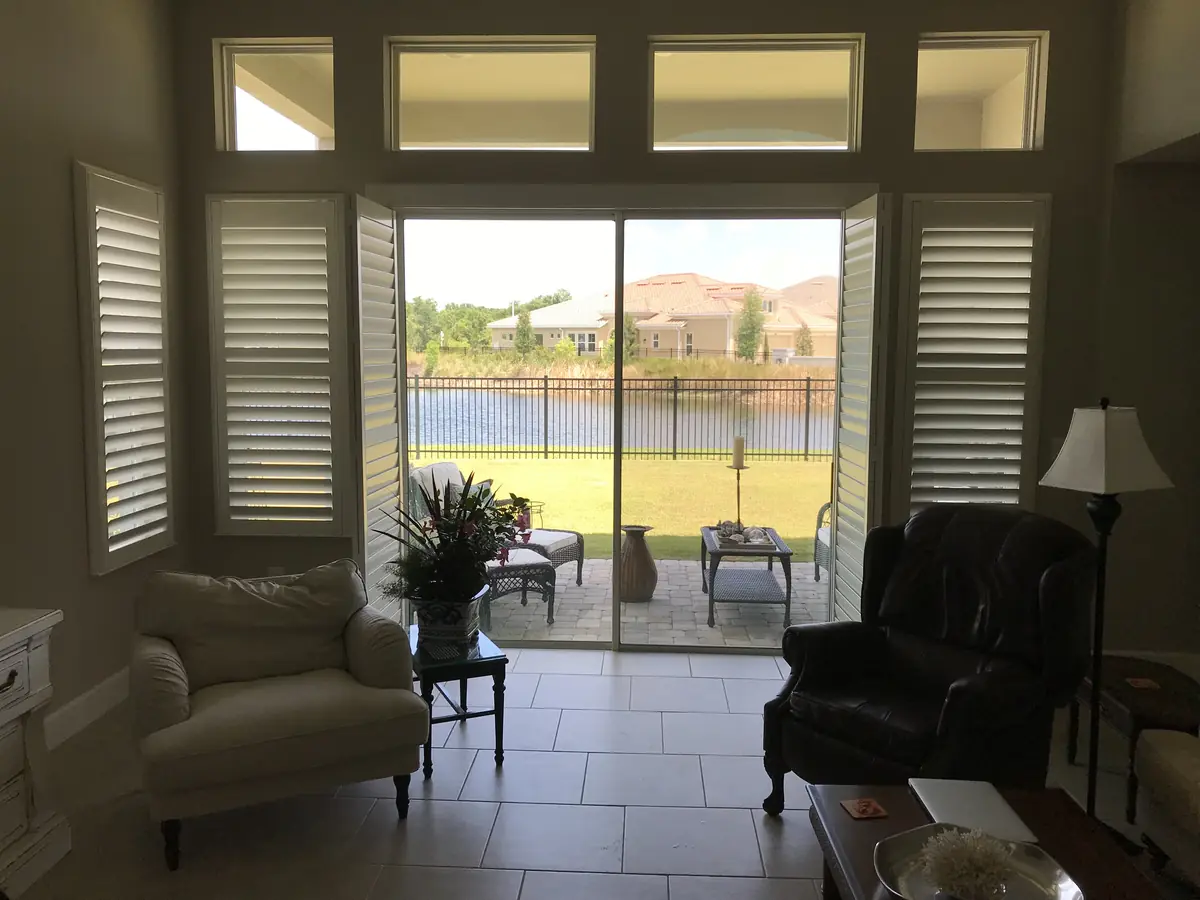
The other shutter option is hinged panels that swing open into the room like a pair of doors, or fold back on themselves. Swung open, they leave the whole glass clear. They need floor space to swing through and wall space beside the door to rest against, so a sofa or dining table close to the slider rules them out. The louvers and frame have to clear the door handle, which is a depth question Marty answers when he measures.
Both versions are built as custom plantation shutters, sized to your door and matched to the shutters on the rest of your windows.
Roller shades on a slider
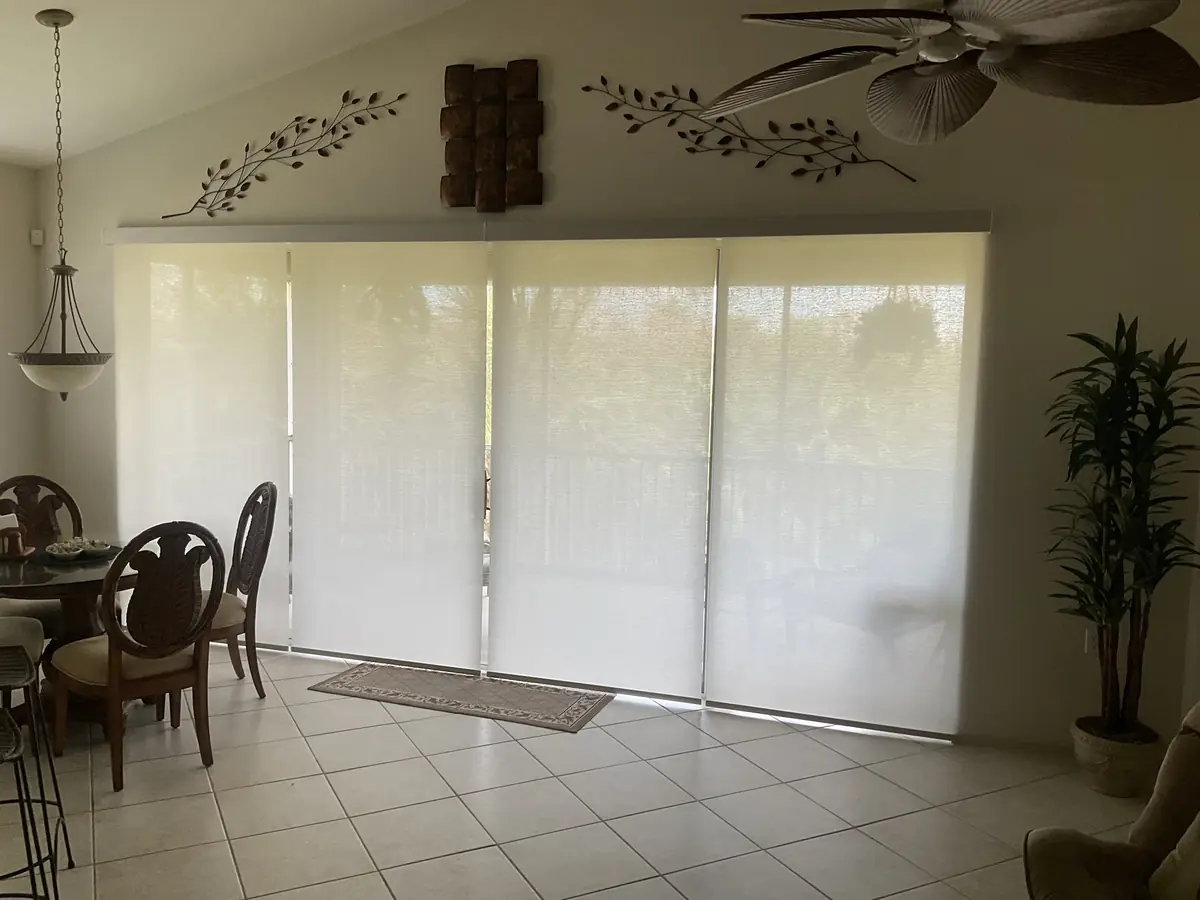
The fabric of a roller shade winds onto a tube mounted above the door. Raised all the way, it disappears and leaves the full view to the lanai or the water. When the shade is down, the fabric decides what it does: a light-filtering fabric softens glare and keeps the room bright while blurring the view, and a room-darkening fabric blocks the light for a bedroom or media room.
Operation is where a shade asks more of you. It goes up or down, with no louvers to tilt, so you raise it whenever you want the door. On a wide slider, splitting the coverage into two or more shades solves most of that: you raise the one over the moving panel and leave the rest down. The shade also has to hang clear of the door handle, which comes down to where the brackets go, and a lowered shade will sway when the door is open in a breeze. With grandchildren in the house, ask about operating the shade without a loose cord.
We hang custom roller shades in light-filtering and room-darkening fabrics, measured to the door like the shutters.
Shutters vs roller shades on a sliding glass door
| Bypass shutters | Hinged shutters | Roller shade | |
|---|---|---|---|
| Using the door | Slide the panels over the fixed side | Swing the panels open | Raise the shade over the moving panel |
| View when open | Fixed side stays covered | Full glass clear | Full glass clear |
| Light control | Tilt the louvers | Tilt the louvers | Up or down; the fabric sets the light |
| Privacy with daylight | Yes, with the louvers angled | Yes, with the louvers angled | Light-filtering fabric, which also blurs the view |
| Room it takes | Depth for the track and the stacked panels | Swing space on the floor, wall to rest against | Only the brackets above the door |
| Three- and four-panel openings | More panels and tracks | More panels to swing | Two or more shades side by side |
| Matches shutters on the windows | Yes | Yes | No |
Which one suits your door
- West-facing living room slider with a TV: shutters. Tilt the louvers up and the low sun goes to the ceiling instead of the screen. A room-darkening shade blocks it too, at the cost of the daylight.
- Lanai door used all day, with a view of the water or the golf course: a roller shade, raised in the day and lowered against the late sun.
- Bedroom slider to the pool: a room-darkening roller shade for sleep, or shutters if privacy with daylight matters more.
- House with shutters on every window: bypass shutters on the slider keep the rooms consistent.
- Wall of glass three or four panels wide: roller shades split panel by panel, or AlumaCore bypass panels to keep the count down.
- Furniture close to the door: bypass shutters or a shade, since hinged panels need room to swing.
Measuring a slider for shutters or shades
Sliders hide a few traps, and they are why we measure every door ourselves. Marty checks how far the handle stands off the glass, how much flat wall there is above the door for a track or shade brackets, and how much wall sits beside it for stacked or swung panels. He also checks the header for level, since a track that is out of level lets panels drift, and looks for anything above the door that would be in the way: crown molding, an air vent, a soffit or a security sensor.
One customer had the whole house done, sliders included:
“We obtained three estimates and Marty was very competitive. He was professional, informative and his work was neat and efficient. We had shutters made for all the windows in the house and for one set of double sliding doors.”
When you are ready, book a free in-home estimate and Marty will bring shutter and shade samples to the door itself. If you are leaning toward shutters, our guide to the best plantation shutter material for Florida covers which material to pick for a slider.
Questions homeowners ask
Can plantation shutters go on a sliding glass door?
Yes. They go on as bypass panels that slide on a track above the door, or as hinged panels that swing open into the room. Bypass panels need no floor space; hinged panels leave the whole glass clear when open.
Will shutters or a shade hit my door handle?
Not if the depth is planned. Marty measures how far the handle stands off the glass, and the shutter frame or the shade brackets are set out far enough to clear it.
Can one roller shade cover a wide slider?
One shade covers a typical two-panel slider. On wider openings, two or more shades side by side work better, because you raise only the one over the moving panel to use the door.
What works best on a west-facing slider?
Shutters, if you want to keep daylight: tilt the louvers up and the low sun hits the ceiling instead of the floor. A room-darkening roller shade blocks far more of it, and a light-filtering shade cuts the glare while keeping the room bright.
Can I have shutters on the windows and a shade on the slider?
Yes, and it is a sensible split in a room where the slider gets heavy use. Pick a shade color close to the shutter finish so the two read together.